Tuscany Wine Region: Complete Guide
Tuscany stands as one of Italy’s most prestigious wine regions, despite contributing only 6% of the country’s total wine production. This central Italian region has earned remarkable respect in the wine world beyond its beautiful landscapes and medieval towns.
Located between the Apennines and Tyrrhenian Seas,Tuscany provides ideal conditions for winemaking. The Sangiovese grape dominates here, comprising 61% of vineyard production and expressing unique characteristics across different growing areas.
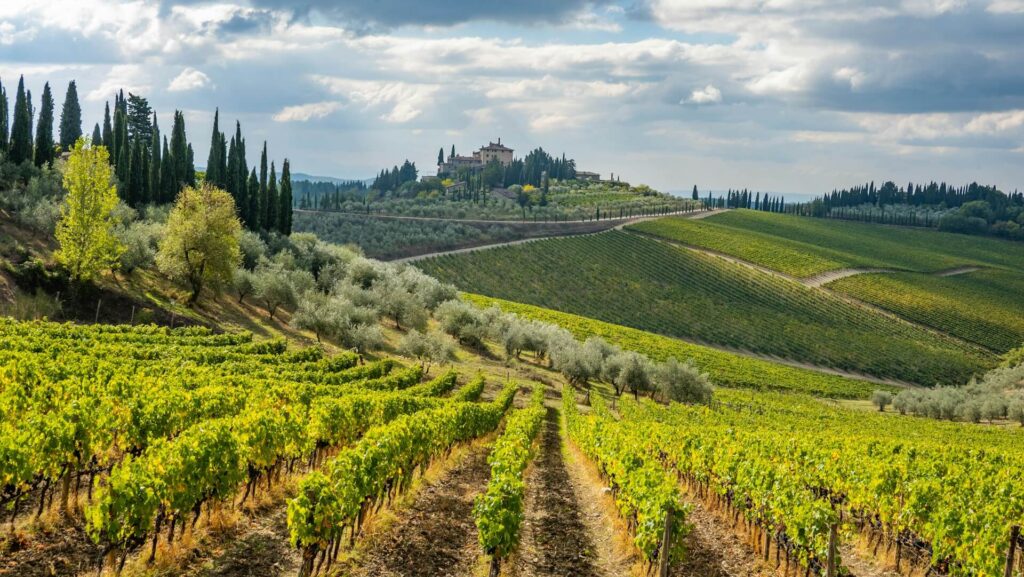
The region’s diverse topography creates distinct microclimates that influence wine quality. Coastal flatlands receive sea breezes, while undulating hills and mountain valleys throughout the interior, capture varying sun exposures. These geographical differences together with wide varieties in soil composition, affect acidity, ripening patterns, and flavor development in the wines.
This natural combination of geography, soil, climate, and traditional viticultural practices makes Tuscany not just a wine destination but an experience of sensory appreciation. Convenient day trips from Florence offer visitors easy access to experience the region’s remarkable wine offerings firsthand.
Explore our Italian Wine Guide.
Signature Wines of the Region
When touring Tuscany, you’ll find notable wines that represent the region’s viticultural heritage. Chianti Classico and Brunello show how Sangiovese grapes can produce different styles of red wine, while wines known as Super Tuscans combine local tradition with international grape varieties to create rich, full-bodied reds. Among the most prestigious offerings, Chianti Classico Gran Selezione has received particular recognition in recent international wine competitions for its exceptional quality and distinctive character. Those who prefer white wines might appreciate Vernaccia di San Gimignano, which offers mineral notes that work well with local seafood preparations.
Notable Wines
Excellence characterizes Tuscany’s signature wines, each showing the region’s varied terroir and wine traditions. These exemplary bottles present the finest qualities from this Italian area.
When exploring Tuscany’s wine selections, consider these key examples:
- Chianti Classico DOCG – Medium-bodied with bright cherry, violet, and spice notes; central to Tuscan wine heritage.
- Brunello di Montalcino – Complex, structured 100% Sangiovese with earthy truffle, leather, and concentrated red fruit.
- Vino Nobile di Montepulciano – Elegant, nuanced Sangiovese blend with fine tannins and subtle florality.
- Sassicaia – The original Super Tuscan, which now gets a specific DOC only for its winery borders, with Cabernet-dominant profile, offering blackcurrant, cedar, and graphite complexity.
- Vernaccia di San Gimignano– crispy, mineral, with almond notes this that is now a DOCG wine but it was the first Italian DOC (in 1966) stands as the historical white wine of Tuscany, with Vernaccia grapes viewing on one of the most beautiful places in the world.
These wines connect you to Tuscan terroir, showing centuries of wine mastery in each sip. The iconic black rooster symbol distinguishes authentic Chianti Classico bottles, representing the historic area between Florence and Siena.
Hidden Wine Treasures of the Region
Hidden among Tuscany’s wine regions exist lesser-known areas that offer remarkable small-production wines. Beyond the notable Chianti and Brunello, a wealth of interesting options await wine enthusiasts, exploring boutique vineyards that offer personalized experiences in family-run estates .
Tuscany’s less-traveled wine regions hold many excellent options for enthusiasts. Candia dei Colli Apuani produces notable crisp Vermentino based wines, from areas near marble quarries, with majestic Apuane mountains to the back and spectacular views over the sea.
Val di Cornia and Suvereto, thanks to the sea influence in the Livorno area, offer excellent Merlot, Syah and Cabernet based wines, together with Vermentino, Ciliegiolo, Ansonica and of course Sangiovese.
The southern areas of Maremma and Capalbio yield bottles that reflect their unique soil and climate conditions, showing how varied Tuscan wines can be beyond the well-known wine areas.
Notable Wines
When visiting these under-appreciated areas, you’ll also notice:
- Carmignano– a very little production area on the Northern hills of Florence where the elegance of Sangiovese has always been blended with Cabernet here called Uva Francesca. Carmignano stands as an ancient terroir where Cabernet Sauvignon was introduced to the blending with Sangiovese during Caterina de’ Medici governance, hundreds of years before what we now call Super Tuscans.
- Elba’s Aleatico Passito– a unique dessert wine produced in limited production in the marvellous Elba island.
- Morellino di Scansano– full-bodied character with strong tannins in Maremma area.
- Pomino– surprising Pinot Bianco and Chardonnay vineyards that offer something different from typical Tuscan wines, close to Florence.
- Montescudaio– fresh and spicy wines made with both traditional Vermentino and Sangiovese or international grape varieties in the countryside near Pisa, where hills receive breeze from the sea and develop eucalypt and red berry notes.
Geography, Terroir, and Climate
The sun-soaked landscapes of Tuscany form one of Italy’s most distinctive wine terroirs, where geography and climate exist in natural balance. Located in west-central Italy, this 22,997 km² region is predominantly hilly (68%), with the Apennines cutting through its central portion and the Tyrrhenian Sea touching its western borders.
The Mediterranean climate varies significantly from coast to inland—coastal vineyard areas receive cooling sea breezes, while interior locations experience broader temperature ranges and notable day-night temperature differences at higher altitudes. These variations contribute to acidity and complexity in the wines. Tuscany ranks as the second largest producer of DOC wines in Italy, highlighting its viticultural significance.
Tuscany’s soils represent an ancient geological history: crumbly galestro and limestone-rich alberese in central regions support Sangiovese’s refined character, while volcanic soils in Grosseto give wines their distinct minerality. Coastal areas feature sandy-clay compositions with excellent drainage. This varied terroir produces diverse wines, each expressing the unique characteristics of their specific area within this historical region.
History
A glass of Tuscan wine contains the influence of Etruscan and Roman practices, medieval monastery conservation, and artistic advancements during the Renaissance period.
Tuscany’s wine heritage extends nearly three thousand years, beginning with ancient Etruscan communities who established grape growing methods that later spread across Europe by the 7th century BC. Through the maritime trades, Etruscans original winemaking techniques were then transformed under the influence from Greek systems of growth found in southern Italy (Magna Grecia), adopting and including different methods and combining their practices with the local ones.
Romans improved winemaking techniques, developing a more organized system of farming in the lands of their Empire
In 1716 Cosimo III de’ Medici created the world’s first regional wine laws, establishing foundations for current regulations. His “Bando Granducale” identified four wine areas, Carmignano, Pomino, Chianti and Valdarno di Sopra and established for the first time in wine history a strict relationship between territorial identity and wine production. These early boundaries preceded today’s DOC and DOCG systems that maintain quality standards and roots in the terroir.
The Supertuscans
During the 1970s, a few winemakers in the Chianti Classico production area, feeling to constrained by the rules of the DOCG production that limited their possibility, for instance, to make a wine 100% Sangiovese, decided to bottle their wines out of the DOCG rules, declassifying them as Table wines or IGTs but maintaining a high price, because they were convinced of the high quality of their production from pure Sangiovese and specific vineyards. At the same time, in his property in Bolgheri area, the Marchese Incisa della Rocchetta was planting and vinifying grapes that at that time were not allowed, like Cabernet Franc, Cabernet Sauvignon and Merlot and his wine, although bottled as Table wine, surprisingly outclassed the most famous Bordeaux wines in a competition of bordeaux blend.
These revolutionary winemakers produced a change in the rules of the Chianti Classico DOCG blending, but at the same time this was the birth of a different kind of wines called Super Tuscan that changed winemaking approaches by combining or replacing traditional Sangiovese with international grape varieties and introduced high quality standards also outside of the DOCG rules. In regions producing Brunello di Montalcino or Chianti Classico, old methods now work alongside sustainable techniques—maintaining Tuscany’s ongoing conversation between historical practices and new approaches.
Important wine-growing areas
Tuscan wine regions offer distinctive terroir expressions. The cooler Chianti Rufina and the historically important Chianti Classico with its Black Rooster symbol represent different aspects of the broader Chianti area.
Similarly, Montalcino’s hills produce the structured Brunello, while nearby Montepulciano creates the refined Vino Nobile from comparable Sangiovese clones. The specific soil composition, elevation, and microclimate of each area creates noticeable differences in acidity, tannin structure, and aromatic profiles in the wines. The region of Bolgheri has gained recognition for its innovative Merlot, Syrah and Cabernet blends that find a perfect microclimate in the Tyrrenian coastal area
Chianti Sub-zones
Beside the Chianti Classico, the Chianti denomination includes several sub-zones that represent distinct viticultural territories and contribute to the region’s renowned wine heritage. The region has several key sub-zones, each giving unique characteristics to their wines.
Colli Senesi, the largest at 3,550 hectares, produces fruit-forward wines with softer tannins. Eastern Colli Aretini (649 hectares) benefits from warmer conditions, while coastal Colline Pisane (150 hectares) yields fresher wines from sea-influenced vineyards. Near Florence, Colli Fiorentini (905 hectares) and its subset Montespertoli (57 hectares) offer balanced wines reflecting their varied hillside terroirs. The high-altitude Rufina sub-zone is known for producing wines with excellent structure due to its cooler climate conditions.
Chianti Rufina
Chianti Rufina represents one of the smallest yet most prestigious sub-zones within the Chianti region, located in the hills east of Florence along the Sieve river. The vineyards here rise up to 500 meters, exceeding the elevation of most Chianti zones, with limestone-clay soils that effectively retain water.
The climate of Rufina, characterized by notable day-night temperature variations and cooling mountain winds, yields wines of remarkable elegance. These significant diurnal temperature variations contribute to the complex flavor development that distinguishes this subregion production whose Sangiovese-dominant blends (minimum 70%) present an attractive profile of violets, herbs, and cherries supported by refreshing acidity.
While Rufina shares structural similarities and aging potential with Chianti Classico, the specific terroir creates a more uniform style—ranging from sleek and mineral-driven to slightly fuller expressions that age well for 5-10 years.
Chianti Classico
Chianti Classico represents the traditional core of Tuscan wine production, spanning 4,083 hectares of vineyards in the breathtaking countryside between Florence and Siena. The distinctive growing conditions come from heights of 250-500 meters, where Galestro and Alberese soils contribute concentration and savory characteristics, respectively, resulting in wines with notable complexity. The region’s diurnal temperature variations significantly enhance the grapes’ flavor development and acidity balance. Mediterranean warmth during the day and fresh temperature at night allow for slow, balanced grape maturation.
Sangiovese forms the central grape variety, required in a minimum of 80% up to 100% in the Chianti Classico DOCG. Other red grapes, both indigenous such as Canaiolo and Colorino, and international like Cabernet Sauvignon, Merlot or Syrah can be blended if the wine is not 100% Sangiovese. Chianti Classico offers three quality levels: Annata (aged 12 months), Riserva (aged 24 months), and the single-estate Gran Selezione (aged 30 months).
As for all the DOCG wines, grapes must be grown and processed within the territorial borders of the production area.
The Black Rooster seal marks authentic products from this region, which is one of the most enchanting landscapes of Italy, with rolling hills, charming mediaeval stone villages and notable wines, reflecting each nuance of this unique amazing territory. The identity of the land reflects the history of wine making in this region, where traditional methods for farming and old system of growth survive together with modern skills. Small boutique wineries, family run, coexist with bigger producers, all respecting and preserving the beauty of this magnificent territory where a great percent of the wineries is now organic.
Montalcino
Located 40 kilometers south of Siena in Tuscany’s Val d’Orcia, Montalcino is one of Italy’s most renowned wine-growing areas. The Sangiovese Grosso grape flourishes in fresh, dry conditions, creating the notable Brunello di Montalcino.
The growing conditions are excellent—hills below 600 meters with varied soils from sandy to limestone-rich, with Monte Amiata providing protection from summer storms.
The production being located on a hill, Northern area offer cooler microclimates, while Southern area receive more intense sunlight and grow grapes on richer soils, so that the Brunellos from Northern slopes differ dramatically from Brunello’s from the South, making the tastings of wines from such a little production area, a deeply intensive and amazing journey.
The lovely village of Montalcino features medieval architecture, topped by the 14th-century Rocca fortress.The town offers visitors charming stone-paved streets and old shops that create an enchanting atmosphere perfect for wine enthusiasts.
Brunello requires five years of aging (two in oak), with Riservas needing six years total. The ageing process can be done both in traditional large oak vats or in smaller French barrels, resulting in different expressions while maintaining the wine’s depth and aging potential.
Montepulciano
Montepulciano sits majestically atop a limestone ridge in southern Tuscany, drawing attention both for its breathtaking Renaissance architecture and its distinguished viticultural heritage. The area boasts a wine tradition dating back centuries, with Sangiovese (locally called Prugnolo Gentile) being the main component of the blend, as well as in the Chianti and Montalcino area, but grown in a very different soil condition, from different geological origins and richer in clay.
With blending rules similar to the Chianti, Vino Nobile di Montepulciano, is a complex wine, elegant, full-bodied yet soft, with cherry and spice notes that must age at least two years before release. For something lighter, the younger Rosso di Montepulciano offers an excellent alternative.
The surrounding hillsides are adorned with vineyards and show, in the Val d’Orcia valley, between Montepulciano, Pienza and San Quirico d’Orcia, one of the most spectacular and breathtaking landscapes of Tuscany.
San Gimignano
Rising dramatically from the Sienese Hills with its distinctive medieval towers, San Gimignano stands as one of Tuscany’s most visually striking wine regions. Known as the “Manhattan of the Middle Ages”, this UNESCO site‘s winemaking heritage dates back to Etruscan times, with Vernaccia even appearing in Dante’s work.
In this area, you’ll find Vernaccia di San Gimignano—Italy’s first DOC wine—characterized by crisp minerality from the region’s chalk soils. The vineyards, planted below 500 meters elevation, also produce San Gimignano Rosso, Rosato, and the luscious Vin Santo.
Visitors can experience the Vernaccia Wine tasting, but also enjoy the visit of the town of san Gimignano, a unique Medieval gem, perfectly preserved inside its old stone walls.
Carmignano
In the rolling hills west of Florence, Carmignano ranks among Tuscany’s most historically significant yet less familiar wine regions. Recognized by Cosimo de’ Medici III as early as 1716, this small appellation gained DOCG status in 1990 after emerging from Chianti Montalbano’s shadow.
This small area contains approximately only 20 wine producers, working across 150 hectares. The flagship wines combine at least 50% Sangiovese with Cabernet varieties—an ancient pairing that existed centuries before the Super Tuscan movement began. After 20 months of aging (three years for Riserva), these wines show complex dark fruit, spice, and earthy notes. The region’s free-draining limestone soils contribute significantly to the distinctive character of Carmignano wines.
For a more accessible option, look for Barco Reale di Carmignano, a DOC from younger vines offering similar character with less aging requirements.
Morellino
In the warmer southern reaches of Tuscany, Morellino di Scansano DOCG represents one of the region’s most interesting wine expressions. This wine can be found in Maremma’s landscape, where the Mediterranean climate and volcanic soils at 150 meters elevation shape its distinctive character.
The wines, made from at least 85% Sangiovese (locally called Morellino), offer intense ruby hues with cherry, pomegranate, and leather notes. You can enjoy them young—released just eight months after harvest—or try the more complex Riservas, which mature for two years with one in oak. Like many wines in Tuscany, Morellino di Scansano demonstrates the remarkable aging potential of Sangiovese.
These structured reds pair well with regional specialties like wild boar or pasta with ragù. The area offers additional attractions: Saturnia’s thermal baths and Cpalbio and Montemerano medieval architecture.
Bolgheri
Bolgheri is one of Tuscany’s most prestigious coastal wine regions, located along the Tyrrhenian Sea about 100 kilometers southwest of Florence. Its moderate Mediterranean climate, influenced by cooling sea breezes, creates ideal conditions for Bordeaux varieties like Cabernet Sauvignon, Merlot, and Cabernet Franc.
The region’s varied terroir – a mix of clay, sand, and limestone soils – adds complexity to its wines. Bolgheri is known as the birthplace of “Super Tuscans,” even though it now gets its Bolgheri and Bolgheri Superiore DOC appellation, which includes some of the most famous brands like Ornellaia, and Guado al Tasso. A separate DOC is dedicated to the limited territory of Sassicaia (which received its own specific Sassicaia DOC in 2013), where the renovation of this wine area took place at the end of the 60’s, thanks to the intuitions of Marchese Mario Incisa della Rocchetta. The appellation changed significantly since the 1980s, growing from white and rosé production to include the powerful, elegant reds that now form its prestigious reputation.
Pomino
The Pomino wine region sits within the municipality of Rufina, holding a distinctive place among Tuscan vineyards. These vineyards stand at 400-700 meters above sea level, where cooler temperatures help maintain grape acidity. Southwest-facing slopes with sandy, clay-rich soil create excellent growing conditions that have been recognized since 1716 by the Bando Granducale of Cosimo III de’ Medici.
White wines from Pomino primarily consist of Chardonnay, Pinot Bianco, and Pinot Grigio (at least 70% of the blend), while red varieties contain a minimum of 50% Sangiovese, with additions of Merlot and Pinot Nero. The region has approximately 66 hectares under vine. Notable products include Vin Santo, which ages three years in oak and contains at least 15.5% alcohol, and Spumante produced using the traditional method.
Cortona
Cortona rises in the eastern part of Tuscany, covering 400 hectares of vineyards on slopes near the Umbrian border in Arezzo province. At almost 600 meters above sea level, its unique mesoclimate supports excellent grape growth, especially Syrah, which makes up 80% of the region’s 450,000 bottles produced yearly.
Cortona’s wine history extends to Etruscan times, though it only gained DOC status in 1999. Any winery visit cannot be separated from the visit to the town which is worth visiting for its magnificent, perfect beauty. The characteristic Rosso Cortona blends with 50-60% Syrah mixed with Merlot, the white wines are made from Grechetto and Chardonnay. The traditional Vin Santo, aged for at least 33 months, is worth trying.
Candia Colli Apuani
The rugged, mountainous terrain of Candia Colli Apuani occupies Tuscany’s northwestern corner, where the Apuan Alps meet the Ligurian Sea. This small 27-hectare DOC, established in 1981, benefits from a distinct microclimate where maritime breezes moderate temperatures across terraced vineyards.
The wines capture the essence of their unique terroir—siltstones, clays, and quartz-feldspathic soils add a distinctive minerality. Vermentino dominates white production (minimum 70%), offering vibrant yet low acidity and aromatic complexity. For reds, Sangiovese (60-80%) mingles with indigenous varieties like rare Barsaglina.
This ancient winemaking region, referenced in texts from 200 BC, includes the picturesque municipalities of Massa and Carrara, showcasing the region’s rich cultural heritage. These wines represent the convergence of Mediterranean influences and mountain protection that creates Candia’s singular expression.
Montecarlo
Montecarlo sits between Lucca and Pisa in northern Tuscany, notable for its distinctive wine tradition dating back to Roman times. Previously called “Vivinaia”, this hill got the name Monte Carlo in honor of Prince Charles (Carlo) son of King John of Bohemia, liberator of Lucca from Pisan occupation. The prince, who became Emperor under the name Charles IV, came to Monte Carlo several times.
The area produces DOC-designated wines that stand apart from typical Tuscan offerings. The whites combine Trebbiano with varieties like Sémillon, Sauvignon Blanc, and Pinot Bianco, creating some of the region’s most interesting white expressions. The reds, while based on Sangiovese, include international grape varieties such as Merlot, Cabernet Roussanne and Syrah, making Montecarlo wines a unique DOC in the Tuscan landscape.
Colline lucchesi
The Colline Lucchesi area lies in northern Tuscany surrounding the historic city of Lucca. This wine appellation, one of the oldest in Italy, established as a DOC in 1986, produces wines with distinctive character influenced by clay soils and a climate moderated by both the Apennines and Tyrrhenian Sea.
The reds contain primarily Sangiovese (45-80%), often combined with Canaiolo, Merlot, and Syrah. White wines feature Trebbiano Toscano (40-80%) along with Vermentino and Grechetto as well as Sauvignon blanc and Chardonnay. The appellation divides into two sections separated by the Serchio River, which provides important ventilation for the vineyards. The clay and gravel soil composition particularly creates favorable conditions for Merlot cultivation throughout the region.
Valdarno
The eastern areas of Tuscany include Valdarno di Sopra, one of the region’s most distinctive wine production areas. Located between Arezzo’s plains and Florence’s hills, this territory benefits from both Apennine and the Arno River influences, creating excellent conditions for grape maturation.
Wine production in this area dates back to Etruscan times, though it only received DOC status in 2011. The region produces notable reds Sangiovese, Cabernet Sauvignon, and Trebbiano, Malvasia bianca and Chardonnay whites, often made into single-varietal wines that highlight the characteristics of the limestone-rich soils.
The west-southwest facing vineyards receive optimal sun exposure, while appropriate rainfall contributes to wines with remarkable structure and balance. The area’s wines have gained international recognition, in recent times thanks to a new generation of young producers, farming organically in small boutique wineries.
Montescudaio
The historic wine region of Montescudaio extends across the Pisan hills, where centuries of viticultural tradition have shaped both landscape and cultural identity.
Sangiovese remains the primary grape, but this DOC is renowned for its Cabernet Franc, Cabernet Sauvignon, and Merlot based wines. These grapes show different results due to the local microclimates that change with elevation—some vineyards at heights of 1,300 feet inland. This terroir gives distinctive elegance to DOC-classified wines that received national recognition as early as 1887. Its unique soil variability contributes significantly to the depth and character that distinguishes wines from this sub-region.
Val di Cornia
Val di Cornia, nestled between the provinces of Pisa and Livorno, is a maritime-influenced wine region renowned for its gentle sea breezes that impact both grapes and the character of the wines. After receiving its DOC status in 1989, this coastal area has developed a distinct winemaking identity rooted in calcareous soils and marine deposits.
The region presents a blend of tradition and modern approaches. Sangiovese forms the foundation for many reds and rosés, while French varieties like Cabernet Sauvignon and Merlot have adapted well to this local environment. The perfectly arranged geometrically perfect campaigns showcase the meticulous attention to detail in vineyard management. Val di Cornia Suvereto DOCG is particularly noted for producing structured red wines, while the region’s sweet Ansonica Passito offers honeyed complexity.
Visitors can explore the charming municipalities of Suvereto and Sassetta along the Etruscan Coast wine road, pairing local whites with panzanella or full-bodied reds with traditional Tuscan meat dishes.
Colline Pisane
Colline Pisane sits in western Tuscany’s undulating landscape, representing the Chianti zone closest to the Tyrrhenian Sea‘s maritime influence. This proximity creates a distinctive terroir where cool sea breezes moderate the Mediterranean climate, yielding floreal wines with vibrant acidity and softer lower tannins than their inland counterparts.
The Pisan hills hold winemaking heritage dating to Etruscan times. The area produces notable Chianti Colline Pisane DOCG expressions alongside Bianco Pisano di San Torpè DOC and Montescudaio DOC wines. Like other Chianti wines, those from Colline Pisane must contain at least 70% Sangiovese up to 100%, to meet DOCG requirements.
The region’s wines—less austere than central Chianti—complement traditional Tuscan cuisine well, their maritime character expressing itself through approachable fruit and elegant structure.
Elba
Rising from azure waters of the Tyrrhenian Sea, Elba island stands as one of Tuscany’s most distinctive viticultural territories, where maritime influences create a unique winemaking environment. The area features varied soils—mineral-rich eastern zones contrasting with granitic western terrain—under a Mediterranean climate of warm 24°C summers and mild 10°C winters.
Sangiovese dominates red production, while Ansonica, Trebbiano, and Vermentino produce vibrant whites reflecting the coastal terroir. The region’s commitment to quality is demonstrated through the Elba DOC designation, which highlights the distinctive character of wines produced on the island. Aleatico Passito DOCG deserves attention as a prized dessert wine made from late-harvested grapes that capture Elba’s essence.
Wine culture here connects with centuries of history, from Roman influences to Napoleon’s brief reign. Visitors can experience terraced vineyard landscapes, intimate cellar tastings, and local festivals celebrating the island’s viticultural heritage alongside seafood-focused cuisine.
Monteregio di Massa Marittima
In southeastern Tuscany’s Grosseto province lies Monteregio di Massa Marittima.
This DOC, established in 1994, spans seven communes including Massa Marittima and Follonica, where mineral-rich clay soils and Tyrrhenian Sea breezes create unique terroir expressions.
The region grows primarily Sangiovese and Syrah for ruby and fruity reds, alongside Ansonica, Trebbiano, Vermentino, and Viognier to produce floreal and delicate whites across 99 hectares. Following decline from war and phylloxera, these vineyards have seen resurgence since the 1990s.
A special mention goes to the Vin santo Occhio di Pernice, a velvety sweet wine made with red grapes, for its intense aromas of ripen fruit with chocolate notes and a long final.
Visitors can explore medieval towns like Massa Marittima and Monterotondo Marittimo while enjoying local gastronomy with their wine tastings.
Montecucco
The understated elegance of Montecucco anchors the southwestern corner of Tuscany, positioned between the renowned regions of Morellino di Scansano and Brunello di Montalcino. Since earning DOC status in 1998, this hidden gem has quietly produced exceptional Sangiovese-based wines from its mineral-rich volcanic soils.
Nearly two-thirds of the region’s 800 hectares follow organic viticulture practices. The Mediterranean climate, moderated by Monte Amiata and the Tyrrhenian Sea, creates perfect conditions for wines that rival their famous neighbors. The region achieved additional recognition when Montecucco Sangiovese was elevated to DOCG status in 2011.
With extremely low yields of seven tons per hectare, Montecucco prioritizes quality over quantity. The biodiversity of the area shows how vineyards exist alongside olive groves and chestnut orchards in one of Italy’s most naturally preserved territories.
Capalbio
At Tuscany’s southernmost edge, Capalbio represents the essence of a region where wine production and history blend seamlessly. Situated on a green hill overlooking the Tyrrhenian Sea, this medieval enclave offers a wine experience rooted in authenticity.
After receiving DOC status in 1999, Capalbio’s wines express the area’s unique terroir. You’ll find reds featuring Sangiovese, softer and warmer here than in other parts of Tuscany and bold Cabernet Sauvignon, whites showcasing mineral Ansonica and crisp Vermentino. Capalbio is one of the 13 municipalities included in the Colli di Maremma wine region, contributing to its rich viticultural diversity.
Between sips, visit the well-preserved uphill fortified village of Capalbio, walk through ancient streets, or go to nearby Lake Burano Nature Reserve—a 410-hectare sanctuary of biodiversity managed by WWF.
Pitigliano
Perched dramatically on volcanic tuff plateaus, Pitigliano presents a distinctive terroir that shapes its notable viticultural identity. The town’s volcanic “tufo” soils add mineral complexity to wines produced at approximately 300 meters elevation.
Bianco di Pitigliano DOC stands as the region’s primary white, mainly crafted from Trebbiano Toscano often combined with Malvasia and Sauvignon for greater aromatic complexity.
The historically significant kosher wines produced under La Piccola Gerusalemme label reflect Pitigliano’s Jewish heritage. When visiting, consider timing your trip around SettembrediVino to see the ancient cliff-carved cellars while sampling wines that capture the essence of these remarkable tufa hills.
Main Grape Varieties
Tuscan wines feature several native red grape varieties, with Sangiovese standing as the region’s principal grape. Sangiovese grosso, a larger-berried clone, is used for Brunello di Montalcino production, while supporting varieties such as Ciliegiolo, Canaiolo, and Colorino often appear in traditional blends alongside the main grape.
These secondary varieties contribute additional complexity, deeper color, and help to moderate Sangiovese’s sometimes firm tannins, creating the characteristic taste profile of Tuscan wines. Sangiovese dominates the Tuscan landscape with two-thirds of plantings and represents 85% of the region’s red wine volume.
Sangiovese
Sangiovese represents one of Italy’s most historically significant grape varieties, with its history extending back to Etruscan times. Its name comes from “sanguis Jovis” (blood of Jupiter), reflecting its important position in Italian wine heritage. DNA profiling conducted in 2004 revealed that Sangiovese is actually a cross between Ciliegiolo and Calabrese Montenuovo.
A glass of Sangiovese offers bright red fruit flavors balanced by pronounced acidity and structured tannins. The grape’s thin skin and late-ripening nature require careful cultivation, particularly thriving in Tuscany’s clay-limestone soils. As these wines age, initial cherry and plum notes transform into complex leather and tobacco characteristics.
Sangiovese shows its purest form in Brunello di Montalcino, and in many Chianti Classico producers, while other Chianti wines and the Vino Nobile di Montepulciano often combine it with complementary varieties. These wines pair excellently with regional cuisine, their natural acidity cutting through rich dishes and fatty meats.
Sangiovese grosso
Sangiovese grosso features distinctive physical traits that set it apart within its family. It’s identifiable by larger berries and thicker skins, which result in full-bodied, complex wines with excellent aging potential.
The grape variant grows well in Tuscany’s clay-limestone soils, especially in Montalcino where it produces Brunello di Montalcino. The grape requires patience, typically reaching harvest in late October after a long growing season that develops its rich flavor profile of plum, cherry, and subtle herbaceous notes. Its wines are known for their notable lively acidity which contributes significantly to their food pairing versatility.
A Sangiovese grosso wine represents Tuscan tradition in refined form. These wines show pronounced tannins and acidity, often matured in oak that adds vanilla and coffee notes—a characteristic expression of the variety’s sensitivity to its growing environment.
Ciliegiolo
Cherries burst forth in the glass of Ciliegiolo, a historic Tuscan variety whose very name honors its distinctive fruit character. You’ll find this grape primarily in Maremma’s warm hillsides, where it thrives in Mediterranean conditions with proper canopy management to prevent sunburn.
Recently experiencing a renaissance, Ciliegiolo appears both as a varietal wine and blending component alongside Sangiovese, where it contributes softness and vivid color. Various approaches in production—from ambient yeast fermentations to careful oak regimens—create styles ranging from light and approachable to surprisingly complex. The grape’s smooth tannin profile makes it particularly suitable for early consumption.
When exploring Tuscan wines, look for quality bottlings, then pair with Peking duck to complement Ciliegiolo’s bright acidity and early drinkability. This versatile grape also grows in Umbria, Liguria, and Lazio, each region expressing unique interpretations of its cherry-forward profile.
Canaiolo
While Ciliegiolo showcases Tuscany’s cherry-bright expressions, another historical variety with equal significance deserves attention: Canaiolo, once dominated Chianti blends before Sangiovese claimed primacy.
Canaiolo presents an elegant, ruby-red appearance in the glass, quietly expressing its character. Its medium-bodied profile offers fresh red fruit notes combined with herbal nuances and occasional eucalyptus touches. The name of this authentic Tuscan variety may derive from Latin “dies caniculares”, referring to the summer heat period. The traditional Govorno method of partially drying grapes added to prolong the fermentation helped these wines develop additional aromatic complexity.
In culinary pairings, Canaiolo works well with pasta featuring meat sauces or hearty stews. This variety performs well in blends, where it softens Sangiovese’s tannins while adding fruit-forward freshness. After decades of decline, Canaiolo now experiences a resurgence through dedicated clonal research and renewed appreciation so that many producers, especially in the Chianti Classico, are now bottling it in purity.
Colorino
Colorino is Tuscany’s color-rich native grape variety, one of the region’s most distinctive indigenous grapes. This small-berried variety grows primarily in Florence, Siena, Arezzo, and Pistoia, where it favors well-drained calcareous clay soils.
Traditionally used in Chianti blends, Colorino contributes intense ruby-red colors and structural elements without dominating the wine’s character. Its flavor profile includes pronounced notes of ripe cherries, blackberries, black pepper, and tobacco, with firm tannins and bright acidity. The grape’s hardy and rustic nature makes it particularly adaptable to Tuscany’s varying cultivation conditions.
After nearly vanishing in the 1960s, Colorino has seen renewed interest and now appears in single-varietal wines. Similar to Bordeaux’s Petit Verdot, this grape shows significant potential when paired with red meats, aged cheeses, and traditional salumi.
Aleatico
Aleatico represents a notable variety in Tuscany’s viticultural landscape, distinguished by its unique aromatic profile. This grape grows especially well on the island of Elba, where Mediterranean climate and mineral-rich soils develop its complex character. The soil’s composition of sandy loam provides excellent drainage that contributes to the grape’s optimal development.
The small, tightly clustered grape with deep purple berries produces wines of significant intensity.
When made using the passito method—drying grapes for at least 10 days to concentrate sugars—Aleatico Passito dessert and meditation wine shows its true qualities.
This wine offers an aromatic mix of cherries, strawberries, and rose petals. Its taste presents a pleasing balance of sweetness and warmth that develops into rich jam and chocolate notes as it ages, finishing with hints of spice and gentle bitterness.
Foglia Tonda
Foglia Tonda is an antique indigenous red grape variety, very similar,in the shape of its leaves and the berries of the grapes, to the natural wild grape vines.
Foglia Tonda is very rare now in Tuscany, it mostly resists in the Valdarno wine area where the lower impact of modern viticulture made it possible to maintain old systems of growth like the “Viti maritate” and to let antique grape varieties survive.
It can be made as a single varietal or blended with Sangiovese, offering a distinctive character within Tuscan viticulture. Foglia Tonda wines display a garnet-red color with violet reflections and intense floral aromatics. These wines provide a dry, full-bodied experience featuring vibrant notes of ripe red fruit and dried plums. Typically harvested in late September, the variety ripens slowly despite producing vigorous yields.
These wines perform well with both steel and terracotta vinification methods, and sometimes benefit from aging in barriques. The variety shows remarkable resistance to mildew and other common vineyard diseases, making it attractive to producers focused on sustainable viticulture practices, especially the new generation of winemakers of Tuscany, fond of natural and organic wines .
Merlot
Merlot has established itself as one of Tuscany’s signature international grape varieties, contributing both to prestigious single-varietal wines and celebrated Super Tuscan blends, despite its French origins.
While Merlot adapts to various soils across Tuscany, it performs best in specific terroirs. Beyond Bolgheri, it grows in the Maremma coast and appears in small quantities within Chianti blends, where it adds roundness to Sangiovese’s angular structure.
Merlot thrives particularly in the Bolgheri and Maremma area, where the coastal climate brings out its rich plum and cherry notes. The grape shows remarkable aging potential when properly managed in the Chianti Classico region.
The variety’s vigor requires intensive pruning and early harvest to control yields and ripening—essential for preserving concentrated flavors. When properly cultivated, Tuscan Merlot offers a sensuous mouthfeel with complex spice notes, especially after oak aging. Its reputation as a smooth, velvety wine comes from its thinner skins and fewer seeds compared to other varieties.
Cabernet sauvignon
Even if we commonly refer to Cabernet Sauvignon as a key part of Tuscany’s international grape selection since its introduction in the 1970s, it has been present in Tuscany since long before.
Formerly called ‘Uva Francesca,’ this adaptable grape performs well in Tuscany’s from 1716 when in the Bando Granducale by Cosimo III de’ Medici it is mentioned, blended with Sangiovese, in the Carmignano wine area, where it adds structure and aging potential to local traditional grapes.
Nowadays the Cabernet Sauvignon is cultivated in almost all the wine regions of Tuscany where the different soil conditions and microclimates creates peculiar ripening conditions for Cabernet Sauvignon grapes.
This variety shows its best characteristics in coastal Bolgheri and certain Chianti Classico areas such as Greve, where moderate temperatures and varied soils highlight its qualities.
Tuscan Cabernet typically offers concentrated blackcurrant and cherry flavors, with tobacco and green pepper undertones. Oak aging adds vanilla and spice notes, while the high tannins characteristic of this grape provide structure and aging potential.
The Super Tuscan blends that combine Cabernet with Sangiovese represent an excellent fusion of international style with regional character.
Cabernet franc
Cabernet Franc has established a distinctive position despite being less widespread than its relative Cabernet Sauvignon in Tuscany’s vineyards. Covering just 4,027 hectares, this variety contributes herbaceous character and bright red fruit aromatics to notable Super Tuscan blends, and in Bolgheri DOC wines.
Tuscan Cabernet Franc presents black cherry and blackberry notes, often with leather, chalk, and pencil lead aromas. When aged in French oak, the wine develops mocha and cinnamon undertones that add to its natural complexity.
Syrah
Syrah plays a small, yet important role in Tuscany, covering about 1,068 hectares mainly in the Cortona and Lucchese areas, as well as in Bolgheri and in the Chianti Classico where it is mostly blended to the Sangiovese, adding depth and character to the wine. The most significant examples appear in Cortona DOC, where rules require at least 85% Syrah in bottles labeled with this varietal name.
Tuscan Syrah typically shows deep dark colors with strong black fruit characteristics—blackberry and cherry—alongside distinctive black pepper and balsamic qualities. The clay and marl soils combined with Mediterranean breezes produce wines with notable structure and aging capability. These wines thrive particularly well in the region’s well-drained soils which contribute to their distinctive character.
Pinot nero
Though originating from the legendary slopes of Burgundy, Pinot Nero has found a distinctive expression in Tuscany’s cooler foothill regions like Mugello and Casentino where the peculiar environment and microclimate allows the perfect balance of vineyards, fir forests, chestnut groves and olive groves. Despite cultivation challenges, Tuscan Pinot Nero production continues to grow, yielding wines of remarkable elegance, with its cherry flavours and floral notes.
Tuscan expressions include Pomino DOC and Pomino Pinot Nero DOC in the small area of Pomino, North of Florence, where Pinot Noir together with other French varieties has been introduced and cultivated since 1855.
Chardonnay
Chardonnay has established a distinct position in Tuscany’s viticultural landscape, setting itself apart from the region’s more celebrated international varieties.
Production areas in IGT Toscana from Lucca hills, Chianti area, Bolgheri, Upper and Lower Maremma now focus increasingly on quality through careful site selection for this fragile variety. These wines show a pale straw-yellow appearance with shimmering golden reflections, offering fresh citrus and tropical fruit aromatics. The taste presents a crisp, mineral-driven palate with a balanced medium-long finish.
Oak aging and selective malolactic fermentation can add complexity while maintaining freshness.
Trebbiano
Trebbiano Toscano serves as the primary white grape of Tuscany, showing great adaptability despite its relatively neutral flavor profile. This productive variety grows throughout the region, recognizable by its medium-sized yellow-green grapes and pentagonal leaves with characteristic wavy surfaces. The grape adapts well to various Tuscan growing areas, from Chianti Classico‘s marl soils to Maremma‘s sandler terrain.
Trebbiano-based wines typically present light, crisp expressions with straw-yellow colors and fresh acidity.
While traditionally included in Chianti blends, since it’s not admitted anymore in the Chianti Classico DOCG, it still plays an important role in Vin Santo del Chianti production. This traditional, beloved dessert wine is made with grapes left to dry out on straw reeds before fermentation, to reduce water content and increase sugar content, contributing to the survival of Tuscany’s traditional dessert wine.
Some producers have started focusing on this variety through careful clone selection and improved winemaking techniques, moving from quantity-oriented to quality-oriented productions. The Trebbiano grape is now rediscovered for the production of orange wines, with long skin contact maceration often held in a terracotta jar.
Malvasia bianca
Malvasia Bianca is one of Tuscany’s significant white varieties with origins tracing back to Greece. It needs dry climates and sloping terrains to avoid its susceptibility to mildew. This golden-hued wine has a distinctive heavy body and soft, round texture. Its aromatic profile features notes of peaches, apricots, and tropical fruits like lychee.
In Tuscany, Malvasia rarely appears as a solo performer, instead serving as a supporting character in blends where it adds richness and aromatic complexity. It appears in traditional productions and especially in wineries that have the luck to maintain old vineyards alive and in the production of Vin Santo, where its natural sweetness becomes prominent.
Together with the Trebbiano grape it is now rediscovered for the production of orange wines, fermented with stam and long maceration in contact with the skins that gives marvellous bronze and golden nuances to the colour and mineral flavours to the taste
Malvasia nera
Malvasia Nera is an ancient Mediterranean import with a fascinating lineage tracing back to Greek influence. This thin-skinned varietal survives in Chianti Classico and Southern Chianti’s area, where it has historically been blended with Sangiovese but is increasingly showcased as a standalone wine.
Tasting Malvasia Nera in purity (even rare) offers an elegant medium-bodied experience with dark fruit flavors—blackberry, cherry, plum—complemented by floral violet notes and earthy undertones. The well-integrated tannins deliver a smooth finish, enhanced by oak aging that introduces subtle vanilla nuances. The wine’s deep purple hue is immediately striking in the glass.
Vernaccia di San Gimignano
While Tuscany’s reds often capture the spotlight, the region’s storied white grape merits equal attention. Vernaccia di San Gimignano, Italy’s first DOC wine and later raised to DOCG status, grows well in San Gimignano’s calcareous clay and sandstone soils. This ancient varietal, documented since the13th century, produces wines of remarkable character and historical significance.
The wine offers crisp acidity with delicate floral notes and citrus undertones, ending with Vernaccia’s signature: a pleasant bitter almond final. The grape shows itself most purely as a varietal wine, where its golden hue and textured palate reflect place and tradition.
When visiting Tuscany’s wine areas, Vernaccia wine cannot be separated from a visit to its reference town, the unique mediaeval village of San Gimignano.
Vermentino
Vermentino grows beautifully along Tuscany’s coastal areas, particularly in Colli di Luni, Elba Island, Bolgheri and Maremma, where sea influences create its characteristic profile. These pale yellow wines offer citrus notes, floral hints, and subtle Mediterranean herb aromas. Their fresh acidity and intense savory qualities make them refreshingly lively.
Most of these wines mature in stainless steel tanks, which maintains their fresh, fruity character. With 998 hectares of this adaptable grape planted in the region, you’ll find both classic styles and experimental versions aged in amphora or oak barrels.
Ansonica
Ansonica is Tuscany’s local white grape together with Trebbiano, Malvasia bianca and Vernaccia. It’s known as Inzolia in its southern birthplace, Sicily. Typically, Ansonica is a coastal grape that grows well in sunny areas and in fact it thrives in Tuscany in Argentario Elba island and Maremma.
Ansonica wines are typically dry, medium-bodied with balanced acidity and a distinct mineral quality—showing their saline-influenced terroir. They offer aromas of white flowers, citrus, and stone fruits, which develop into more complex balsamic notes with time.
Serve Ansonica chilled at 8-10°C with seafood dishes to appreciate its character. Bottles from Ansonica Costa dell’Argentario DOC highlight this historically significant variety’s adaptability and quality, showing fresh, dry and slightly fruity wines, with a medium to high alcohol content.
Overview on appellations system
The Italian appellation system forms the basis for Tuscany’s wine hierarchy, categorizing the region’s products into three distinct tiers: DOCG, DOC, and IGT. At the top level sit 11 DOCGs, representing Tuscany’s strictest quality guarantee and production standards. The 41 DOCs create the middle tier, offering quality with more flexibility, while six IGT zones allow greater freedom to express regional character.
These 58 designations extend across Tuscany’s ten provinces, each appellation with its own unique characteristics. The IGT classification has been particularly important for Super Tuscans, those revolutionary blends that once operated outside traditional regulations. Tuscany’s wine system changed significantly from the 1970s onward, transforming IGT wines from quantity-focused production to a quality approach that now commands premium prices globally.
3 Wine Destinations for a Perfect One-Day Trip
Tuscany offers three excellent wine areas perfect for day trips, each showing the region’s varied growing conditions. In Chianti Classico, rolling hills provide the ideal setting for Sangiovese grapes among historic medieval villages.
Montalcino sits at higher altitudes, producing powerful, long-lasting Brunello wines that have gained worldwide recognition.
Along the coast, Bolgheri creates a different wine style with its sea-influenced climate and use of international grape varieties, providing an interesting comparison to the more traditional Tuscan wine styles.
Chianti Classico Tour
Between Florence and Siena lies the beautiful Chianti Classico wine region, perfect for a one-day trip. The area features rolling hills with medieval hamlets, vineyards, and olive groves across 70,000 hectares.
Either from Florence or from Siena, you’re only 40 minutes away from Italy’s oldest demarcated wine region. Visit charming towns like Greve, Castellina, or Radda while exploring the area known for its Sangiovese-dominant wines.
Try the three tiers of Chianti Classico—standard, Riserva, and Gran Selezione—each offering increasingly complex cherry notes and tannin structures. For the best experience, visit during spring or autumn when you can enjoy tastings with an authentic Tuscan lunch.
Montalcino’s Brunello Route
South of Siena lies Montalcino, home to Italy’s most prestigious wine, Brunello di Montalcino. This hilltop medieval town sits 40 km south of Siena, with a unique terroir that shapes its legendary Sangiovese Grosso.
The area produces 100% Sangiovese Grosso (here called Brunello) wines, aged at least 50 months and the lighter and younger Rosso di Montalcino. Vineyard altitude and soil variations—from sandy to limestone—create distinctive characteristics in each wine.
Between wine tastings, visit the 1200-year-old Sant’Antimo Abbey and explore Montalcino’s cobbled streets. Monte Amiata provides protection from summer storms while you enjoy three-course local meals paired with both the full-bodied Brunello.
Coastal Bolgheri Vineyards
The beautiful Bolgheri wine region extends along the Tuscan coast, changing former marshy land into an excellent area for rich, bold and structured wines. The sun-filled coastal vineyards enjoy cooling sea breezes, providing perfect conditions for Cabernet Sauvignon, Merlot, Petit Verdot and Syrah grapes to grow well in the sandy and clay soils.
Visitors can explore various locations throughout the region to taste complex red blends. Between stops at different vineyards, many people enjoy walking down Viale dei Cipressi, the famous cypress-lined avenue that signals your arrival in this special wine area. The region offers both traditional and organic growing methods, with many tasting options paired with local Tuscan foods, making for a complete coastal wine experience.
3 Traditional Dishes You Must Try
When visiting Tuscany, you’ll want to taste the region’s traditional food alongside its famous wines.
Pappardelle al Cinghiale features wide pasta with flavorful wild boar ragù, while Ribollita is a filling bread and vegetable soup that shows the practical cooking style of local cuisine. Don’t miss trying Bistecca alla Fiorentina, the impressive T-bone steak from Chianina cattle, cut thick and cooked rare over hot coals.
Pappardelle Al Cinghiale
Pappardelle al Cinghiale represents one of Tuscany’s most iconic culinary treasures, combining wide ribbons of handmade pasta with a rich, slow-simmered wild boar ragù. This dish exemplifies cucina povera—the resourceful countryside cooking that defines Tuscan gastronomy.
The ragù develops its complex character through hours of gentle cooking, as the gamey boar meat tenderizes and mixes with aromatics, herbs, and traditional Tuscan wine. The wide pappardelle ribbons aren’t merely a vessel; they’re designed to capture and hold this intense sauce with each forkful.
For an authentic experience, enjoy this dish with Chianti Classico or Brunello di Montalcino, whose acidity cuts through the richness while complementing the earthy undertones of the wild boar. This pairing honors centuries of Tuscan hunting traditions and regional culinary heritage.
Ribollita Soup
Ribollita warms as Tuscany’s resourceful kitchen creation, named from the Italian “ribollire” (to reboil) because country cooks would heat this hearty soup repeatedly over days, developing its deep flavors.
This centuries-old recipe transforms basic ingredients into nourishing comfort food. The soup builds upon a slow-cooked base of carrot, celery, and onion, combining with soft cannellini beans and nutrient-rich Lacinato kale. Stale bread serves as the essential thickening agent, creating a smooth texture that fills each spoonful. Every bite delivers aromatic herbs, vegetable goodness, and plant-based protein.
In trattorias across Tuscany, each version varies slightly—some offer a more liquid consistency, while others prepare it almost thick as porridge. Traditionally served with a drizzle of peppery Tuscan extra virgin olive oil.
Bistecca Alla Fiorentina
While Ribollita shows Tuscany’s rustic countryside tradition, any study of the region’s food must include Bistecca alla Fiorentina. This striking T-bone steak, cut 3-4 cm thick from young Chianina cattle, weighs 1-2 kg and commands attention.
You’ll observe chefs searing it over wood or charcoal fires, creating that perfect Maillard reaction—charred exterior while maintaining a rare, ruby center. They’ll season it simply with salt, pepper. After just five minutes per side and a brief rest, it arrives at your table.